
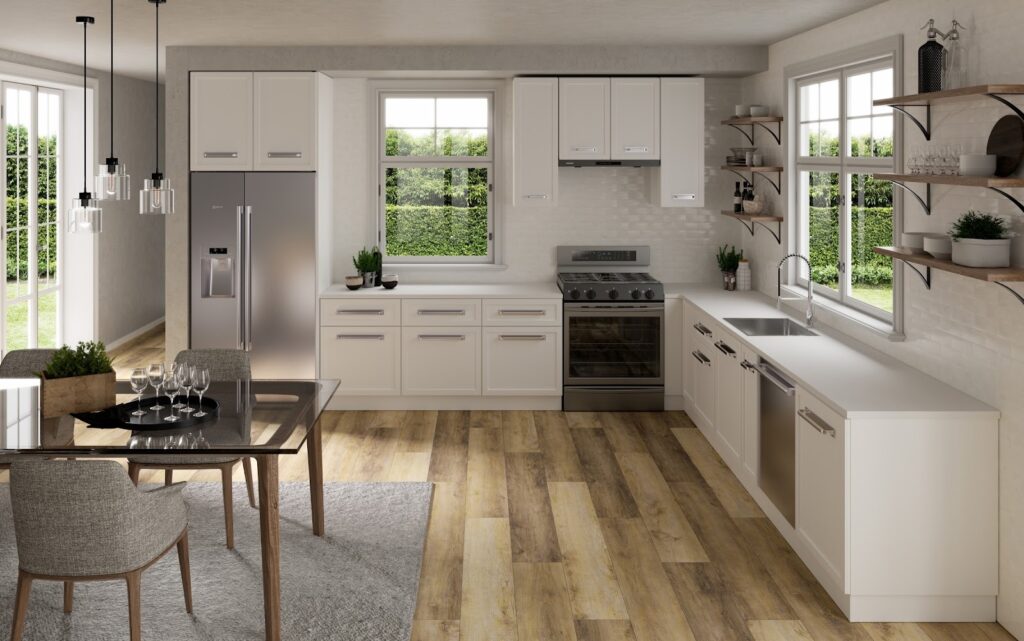
If you’re planning or remodeling a kitchen in the U.S., the L‑Shaped Kitchen remains one of the smartest, most flexible layout choices. Whether your home is a compact city condo or a spacious suburban house, an L‑shaped kitchen layout offers great balance — combining efficiency, storage, workflow and style. In this blog, we’ll walk through why L‑shaped kitchens are trending, how to design one effectively, and share lots of design ideas and real‑life examples you can draw inspiration from. We’ll use the exact target keyword “L shaped kitchen USA” whenever relevant to help with SEO too.
Why L‑Shaped Kitchens Work So Well in the USA
Before we dive into design ideas, it helps to know why L‑shaped kitchens are so widely loved and used.
- Efficient Work Triangle & Smooth Workflow: Because cabinetry and appliances run along two perpendicular walls, you can easily set up the classic “work triangle” — stove, sink, and refrigerator — without long walks between them. That makes cooking, cleaning, and prep smoother and faster. (KitchenAid)
- Great for Open‑Plan Living: If your home connects kitchen → dining → living area, an L‑shaped layout fits neatly. It gives a defined kitchen zone but still keeps things open and social — perfect for modern American homes. (KitchenAid)
- Maximizes Space and Storage: Two full walls for counters and cabinets means lots of storage opportunity — base and wall cabinets, tall units, shelves — without sacrificing floor space. (thealphakitchens.com)
- Flexible & Customizable for Small or Medium Kitchens: L‑shaped kitchens scale well. Whether it’s a tiny apartment kitchen or a mid‑size family kitchen — this layout can adapt. (KitchenAid)
- Opens Up Central Floor Area: Because counters run on walls, the central part of the kitchen stays open — good for movement, and if you have space, a kitchen island or dining table fits easily. (DexDecor)
- Better for Social & Multi‑Purpose Kitchens: L‑shaped kitchens often become social spaces — cooking while chatting with family, prepping meals while supervising kids, or entertaining guests while cooking. (jumbosskitchens)
Because of these qualities, many American homeowners — from city dwellers to suburban families — choose L‑shaped kitchens when designing or renovating.
🔧 Smart L‑Shaped Kitchen Design Ideas & Tips
Here are some of the best ideas and practices to design an L‑shaped kitchen that’s functional, stylish, and future‑ready.
1. Sit Your Work Triangle Right: Plan Stove, Sink & Fridge Wisely
The heart of kitchen functionality is how you place your three key stations: cooktop/oven, sink, and refrigerator. In an L‑shaped kitchen:
- One leg of the “L” can host the sink + prep area.
- The other leg can hold the cooktop/oven — or fridge — depending on space and ventilation. (KitchenAid)
- Make sure there’s enough counter space on either side of sink and stove for safety and convenience. If space allows, leave 15–20 inches (~40–50 cm) on either side of those areas.
This ensures cooking, washing, and prepping flows smoothly without bottlenecks.
2. Use Corner Space Smartly — Don’t Let It Go Wasted
One common challenge with L‑shaped kitchens is the corner where the two walls meet — it can become a dark, under‑utilized space. But with smart storage solutions, you can make corner space work for you:
- Install pull‑out corner shelves or carousels (lazy Susans) for pots, pans, or seldom‑used appliances. (KitchenAid)
- Use corner drawers — they make access easier than traditional deep corner cabinets.
- Combine with overhead cabinets or vertical storage to maximize the height.
This way, you reclaim every bit of space and avoid dead zones.
3. If Space Allows — Add an Island or Peninsula
For medium or larger kitchens, extending the L‑shaped kitchen with an island or peninsula adds big benefits:
- Extra counter space for prep, breakfast bar, or casual dining. (KitchenAid)
- More storage underneath — drawers, shelves, even built‑in trash/recycling, wine fridge, or appliance garage.
- Creates a social hub — great for families, guests, or multitasking when someone cooks and others hang out. (KitchenAid)
Tip: Make sure you keep enough clearance (about 3 ft / 90‑100 cm) around the island for easy movement.
4. Choose Materials & Finish Based on Your Lifestyle — Not Just Looks
An L‑shaped kitchen can take many design styles. Here are a few ideas depending on what you need:
- Compact urban kitchen → light‑coloured cabinets (white, light wood), reflective backsplash, open shelving — makes the space look bigger and airier.
- Family kitchen → sturdy cabinets with soft‑close doors, lots of base storage/drawers, easy‑clean surfaces (quartz, laminate) and enough counter space for prep.
- Modern / luxury kitchen → mixed materials (wood + stone), under‑cabinet LED lighting, matte or textured cabinet finishes for a premium look.
Matching materials with function helps — especially in a layout that will see daily heavy use.
5. Optimize Lighting & Ventilation — Especially in Open‑Plan Homes
L‑shaped kitchens often integrate with living/dining spaces — so lighting and ventilation matter:
- Use overhead lighting plus under‑cabinet lights to brighten prep areas.
- If you have a cooktop or oven, consider a good overhead hood or vent — especially if the kitchen opens to living areas.
- Natural light helps too — try to keep at least one leg of the “L” near a window if possible (sink or prep area works well).
6. Storage Smartly — Mix Base Cabinets, Drawers, Tall Cabinets & Open Shelves
Storage is a major reason to go for an L-shaped kitchen. Combine different storage solutions:
- Base cabinets & deep drawers — for pots, pans, everyday dishes.
- Wall cabinets or tall pantry units — for dry goods, seldom-used appliances, cleaning supplies.
- Open shelves — for everyday dishes, cookbooks, decorative pieces (especially good if you want a lighter, airy vibe).
- Corner solutions (as above) — to avoid wasted space, and still give easy access.
Plus, if you choose modular cabinetry (from a vendor/brand that operates in USA), you get flexibility — which makes an L‑shaped kitchen future‑proof.
7. Make It Social — Extend Kitchen Into Living or Dining Zones
One of the charms of L‑shaped kitchens is how well they integrate with the rest of the home. You can:
- Use one wall of the “L” as a breakfast bar (with stools).
- Add a small dining table or island for meals or casual cooking.
- Keep kitchen layout open so cooking, eating and socialising happen together — perfect for families or entertaining friends.
This approach often turns kitchens into the real heart of the home.
🏡 Real-Life L‑Shaped Kitchen Layout Examples (USA Homes)
Here are some real‑world scenarios illustrating how an L‑shaped kitchen can work beautifully, whether your space is small or generous:
Example 1 — Compact City Apartment Kitchen
- Two walls used for counters: one with sink + prep + lower & wall cabinets, the other with cooktop + slim fridge.
- Light‑colored cabinets (white or pale wood), small or no island — to keep the space open.
- Open shelves overhead for dishes and everyday cookware, to make the kitchen feel airier.
- Compact layout, but still comfortable workflow — ideal for singles or couples in apartments.
Example 2 — Mid‑Size Family Home Kitchen with Island
- L‑shape along two walls: sink + dishwasher on one, cooktop + oven on the other; fridge at the end near pantry.
- A central island with storage drawers, breakfast bar seating, and extra prep space.
- Ample cabinets + pantry unit + vertical storage — for groceries, cookware, small appliances.
- Enough space for multiple people to move — cooking, cleaning, prepping can happen simultaneously.
Example 3 — Open‑Plan Kitchen + Living / Dining in Suburban Home
- L‑shaped kitchen that flows into dining/living area — no walls, lots of light.
- One leg of “L” continues into a peninsula with bar stools — used for quick meals or as a serving counter while entertaining.
- Wall cabinets, tall pantry unit, pull‑out storage, and well‑placed cooktop + sink + fridge for smooth workflow.
- Stylish finishes — wood or mixed materials — to match living room décor, creating a unified home look.
⚠️ Things to Watch Out For — What L‑Shaped Kitchen May Not Be Ideal For
No layout is perfect. Here are some possible downsides or challenges of an L‑shaped kitchen — and how to avoid them:
- Corner cabinet/storage can be hard to access — regular deep corner cabinets are notoriously awkward. Solution: use corner pull‑outs, carousels, or specialized corner units. (KitchenAid)
- Limited space for multiple cooks in very small kitchens — if the kitchen is narrow or small, two people cooking together can feel cramped. In such cases, think carefully before adding an island. (HomesLibro)
- Workflow mistakes if fridge, sink, stove are badly placed — if the “work triangle” is stretched or broken, efficiency suffers. Planning matters. (KitchenAid)
- If the kitchen is large and excessive open floor — it may feel empty or inefficient — sometimes a U‑shape or extra storage wall might make more sense for larger kitchens. (Beautiful Homes)
🎨 L‑Shaped Kitchen Design & Style Ideas Trending in 2025 (USA)
Here are some style & design ideas for L‑shaped kitchens that are popular with American homeowners right now:
- Two‑tone cabinetry — e.g. lower cabinets in darker wood or colored finish, upper cabinets or walls in white or light tone — adds depth and modern vibe.
- Mixed materials — wood cabinets + stone/quartz countertops + stainless or matte hardware. Gives a balanced, high‑end look without being too stark.
- Open‑shelf + closed‑cabinet combo — upper open shelves for dishes, cookbooks, decor; lower closed cabinets for storage. Keeps kitchen airy but practical.
- Island or peninsula with breakfast bar — creates casual dining space and makes kitchen more social.
- Under‑cabinet lighting & good ventilation — especially important if kitchen is part of open‑plan living, to keep cooking fumes controlled and prep areas bright.
- Vertical pantry or tall cabinets — especially useful if floor space is limited; makes use of height for storage.
- Compact appliances / slim fridge / built‑in oven-stove combo — helps optimize small or mid‑size kitchens without compromising functionality.
✅ Is L‑Shaped Kitchen Right for You?
Here’s a quick checklist to help decide if L shaped kitchen USA design works for your home:
| Your Situation / Need | Is L‑Shaped Kitchen a Good Fit? |
| Small or medium kitchen / apartment | ✅ Yes — maximizes wall space, keeps floor open, efficient workflow |
| Open‑plan living or connected kitchen‑dining area | ✅ Yes — kitchen stays integrated, social, and neat |
| Need for good storage + countertop space | ✅ Yes — two walls = lots of cabinets & counters |
| Multiple people cooking or family home | ✅ Often yes — if space allows, maybe with island |
| Want a flexible layout that looks modern/stylish | ✅ Yes — easy to combine with modern finishes, island, open shelf, etc. |
| Concerned about wasted corner space | ⚠️ Only if corner storage isn’t planned well — use pull‑outs/carousels |
| Big kitchen area with many appliances / large cooking zones | ⚠️ Might need more walls / consider U‑shape or extra cabinetry along a wall |
If your needs align more with the ✅ conditions, an L‑shaped kitchen is likely a smart, long‑lasting choice.
Final Thoughts — L‑Shaped Kitchen USA: A Balanced, Flexible Layout for Many Homes
The L‑shaped kitchen remains a favourite design for a reason: it balances functionality, storage, space-efficiency, and style in a way few other layouts can. Whether you live in a compact condo, a family home, or a modern open‑plan space — an L‑shaped kitchen gives you flexibility to adapt and design based on your lifestyle.
With smart planning — placing sink, stove, fridge thoughtfully for a good work triangle; using corner storage wisely; adding island or vertical storage if space allows — you can create a kitchen that’s beautiful, practical, and future‑proof.